The post The problem with “How’s the Real Estate Market?” appeared first on Cody Croslow Real Estate.
]]>
In truth, the market is different for everyone. If you have a house in good condition, located in East Medford, Central Point, or Eagle Point, listed between about $100,000 and $250,000; the market is great! You can probably get a great price for it, and it will most likely sell very very quick, with multiple offers.
Conversely, if you are looking for the above house as a buyer, you will have to move VERY quick when it pops up on the market, and there will be others in the market with you that are willing to battle it out, so come prepared with your highest and best offer right from the get-go, rather than trying to get a good deal.
As an investor in today’s local market, you will have a bittersweet time. Unfortunately, when the market crashed, there were a lot of people who decided that because prices were down, they were going to get into real estate investments (which is a great place to be, by the way), and so there is a lot of people with a little cash burning a holes in their pockets. That’s not to say you can’t find something and make some good money while investing your hard earned money, but it DOES take effort, and a good agent.
So how’s the market? I guess that depends on you, let’s find out!
Cody
The post The problem with “How’s the Real Estate Market?” appeared first on Cody Croslow Real Estate.
]]>The post Dealing with Multiple Offers as a Buyer appeared first on Cody Croslow Real Estate.
]]>
- Multiple offers right off the bat: When you first put your offer in, there is already at least one other offer.
- Once your offer is in and countered by the seller, an additional offer is brought to the table by someone else.
Please keep in mind that there are no hard and fast rules to buying real estate, and almost everything is negotiable. One of the most important things to do when in a stressful situation regarding your real estate purchase (or at least the attempt) is to keep calm and think your options through. The advice I am giving here is the same advice I would give to a client in a similar situation, but each situation is different. With that said, I’ll jump into two of the most common scenarios.
Multiple offers right off the bat.
This situation is probably the most common multiple offer scenario out there, and coincidentally, probably the easiest deal with. A multiple offer right off the bat is when your agent talks with the listing agent and they let you know that there is at least one more offer already on the property. Do NOT let that dissuade you from looking at the property if it feels like a good fit for you! The easiest way to deal with that situation is to ask yourself two questions: How much do you want this property, and what is the maximum amount of money you are willing to pay for that property? This is called the “highest and best” approach, where you make your highest and best offer, in hopes that someone else’s highest and best is lower than yours. It’s important to remember that there will always be another house that you will fall in love with. It’s okay to get attached to properties, just try to keep in mind that if it falls through, there will be more.
Once your offer is in and countered by the seller, an additional offer is brought to the table by someone else.
So you just received a counter offer from the seller and you are thinking about it for a day, when you get a call from your agent telling you that they were told there is another offer on the table. It’s very easy to get frustrated and want to throw in the towel at this point. Most times, you don’t know what the other offer (or offers) are, and you will have to make some quick decisions. The question at this point is the same as the last situation, “What is this property worth to you?” Once you ask that question, you have two main options.
Your first option is to accept the seller’s counter, get the house under contract and deal with the problems you have with the house later in the transaction (inspection period, financing contingencies, etc.). This works because since the sellers have sent a counter to you already, they have put an offer on the table. If you accept that (counter) offer, they are bound to it! Yes, you are accepting their counter offer and any terms they have regarding that offer, but that puts you in first position in the contract, and you can renegotiate in the inspection period for price or for things that need fixing in the house.
Your second option is to send an additional counter to the sellers to try and get your terms and price. This option will allow them to reject your offer if a different offer is stronger. Ideally, if this is your dream house, I would not take this option, but it depends on you.
Hopefully you will go your whole life buying and selling real estate on a schedule that is comfortable to you and never run into these situations as a buyer, but more realistically, you will have to deal with them at some point. My best advice to you is talk to your real estate agent and come up with a solid plan to carry out, then stick to it!
The post Dealing with Multiple Offers as a Buyer appeared first on Cody Croslow Real Estate.
]]>The post 20 Common Real Estate Terms appeared first on Cody Croslow Real Estate.
]]>
The language of real estate and contracts can be intimidating at the beginning, and to be honest, us real estate agents sometimes forget that most people don’t speak the language like we do. Here I have outlined twenty terms that you may run into in your home-buying process.
Real Estate: Land and improvements (buildings and other structures). Also called Real Property.
REALTOR®: A REALTOR® is a member of a REALTOR® association. Generally, the word RALTOR® refers to a real estate agent.
Listing: A house for sale.
Multiple Listing Service(MLS): In it’s essence, an MLS is a group of realtors working with each other under a set of agreed upon rules and ethics. Usually when an agent uses the term MLS, they are referring to an online database which is where most of the property listings are posted when the seller is using a real estate agent.
Pre-approval: Once someone gets more serious about purchasing a house, they can get a real pre-approval letter from their lender. Their lender will run a credit check, and get a good number to the buyer so they can find out what price range they can actually purchase at.
Pre-qualification: Pre-qualification is the first step in the loan process. There’s no credit check at this point, the bank just does a review of the potential buyer’s income and expenses and give them a pre-qualification letter.
Earnest Money Deposit: A sum of money submitted in a check or promissory note(IOU) to the agent representing the buyer when a buyer puts an offer in on a property for sale. An earnest money deposit is like any other deposit, it says that you (the buyer) are intending on purchasing the house, and you are willing to put up some of your own money to get the ball rolling.
Mortgage: In it’s essence, a mortgage is a loan on a property, with the property in question being used as collateral.
Short Sale: A short sale is a type of “distressed” property where it is being sold for less than what is owed on it. For example: Someone buys a property and gets a loan on it for $100,000. If the market value of the property drops to $50,000, and they still owe $90,000 they are “short” on their mortgage. If they try to sell their house, they(and their agent) will have to negotiate with the bank to deal with the other $40,000 deficiency. These are complicated, but as a buyer with an agent, you should have nothing to worry about
Foreclosure: A foreclosure is where someone has defaulted on their loan, and the bank has taken it back, and the property now becomes a “Real Estate Owned” or REO property.
Contingencies: Contingencies in real estate are things that are built into the purchase contract, that have to be carried out before the sale will be final. Examples of this are Inspections, financing, and due diligence.
Appraisal: When you go to a bank and ask for a loan to purchase a property, they are going to want to make sure that property is worth what you are asking them to loan. The lender will send someone out to do an appraisal, which will give them that dollar amount.
PMI: Institutional lenders like to lend at 80%. That means that if you have a 5% down payment, the bank will be lending out 15% more than their comfort zone. They will sometimes require that the borrower have insurance on that 15%. That insurance is called Private Mortgage Insurance.
Title: Title is really just another way to say that you own the property. If you hold title to a property, you own it.
Escrow: Escrow can be thought of as a third party who holds onto all the moneys and facilitates the terms of the contract. They are impartial to transaction, and makes sure all of the T’s are crossed, and the I’s are dotted. The third party holds onto the funds until all obligations have been completed and once all obligations are completed, the home will change to the new owner and escrow is closed.
Closing Costs: This is a general term that describes all of the monetary costs of doing real estate. A few of these include prorating taxes, escrow fees, and title insurance. Talk to your real estate agent and lender about what is included in closing costs, and what you can expect as a dollar amount.
Due Diligence: A due diligence contingency in a contract allows the buyer to get information like repair costs, permit information, etc. If the buyer finds out that the costs will be prohibitive, they can back out of the contract inside that due diligence time frame.
Contract: A legal written agreement between two parties.
Commission: The money paid to the listing and selling agents as their pay for bringing the buyer and seller together as well as working the deal and making sure all the paperwork is in order.
Assessment: Like an appraisal, but done by the county, to determine how much to charge in taxes.
The post 20 Common Real Estate Terms appeared first on Cody Croslow Real Estate.
]]>The post Jackson County Oregon Property Statistics appeared first on Cody Croslow Real Estate.
]]>It’s a great time to purchase a home! Based on the recent Jackson County Property Statistics published by the Southern Oregon MLS (from November 1, 2012 to January 31, 2013), we have seen a 21% overall price increase in real estate in the past year. This is great news for all those folks out buying real estate in Southern Oregon right now, because it means we are at or very near the bottom, and starting our slow ascent back up. That 21% rate is most likely the result of a combination of the current shortage of inventory, coupled with the large number of buyers out there trying to scoop up properties at rock bottom prices and interest rates. We’ll see what will happen in the next year. Some folks say there is a large “shadow inventory” that the big banks are holding on to, and when those hit the market, the market will drop some more. There are also those who say that isn’t true. Only time will tell.
I have attached the statistics here for you to look at regarding the Rogue Valley’s pricing and sales volumes, but the general idea is that it looks very good for our area.
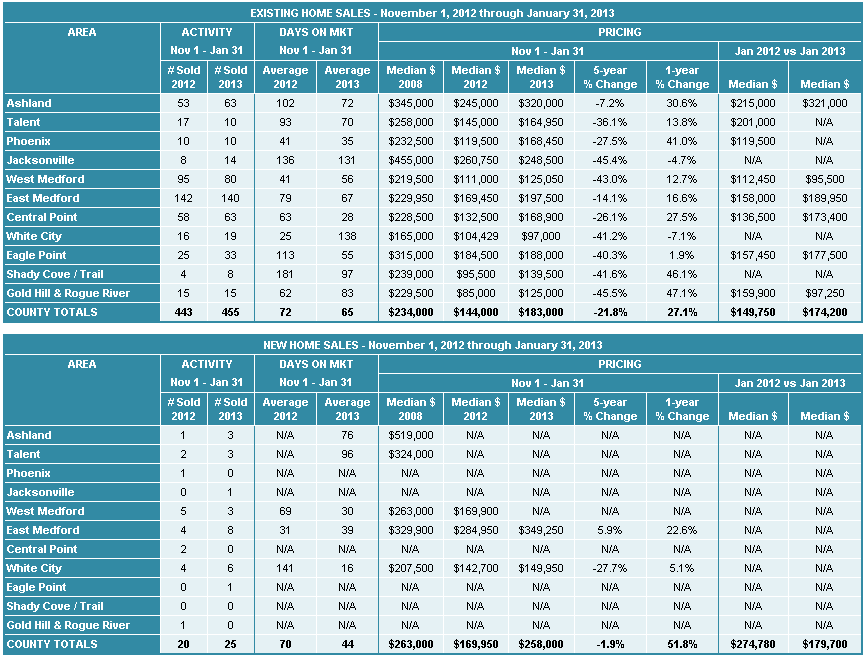
To view this table larger, view the original Jackson County Property Statistics.
If you compare the 5 year change vs the 1 year change, it is a phenomenal difference. There are a few areas (Ashland and Jacksonville) that spike the overall pricing and sales up, so they look a little higher than they are, but we are still seeing 12% or better growth in most areas. This is huge! It means that last year was the best year we have had in a long time, and signals our slow return to a stable market. So go out and buy a house!
The post Jackson County Oregon Property Statistics appeared first on Cody Croslow Real Estate.
]]>